
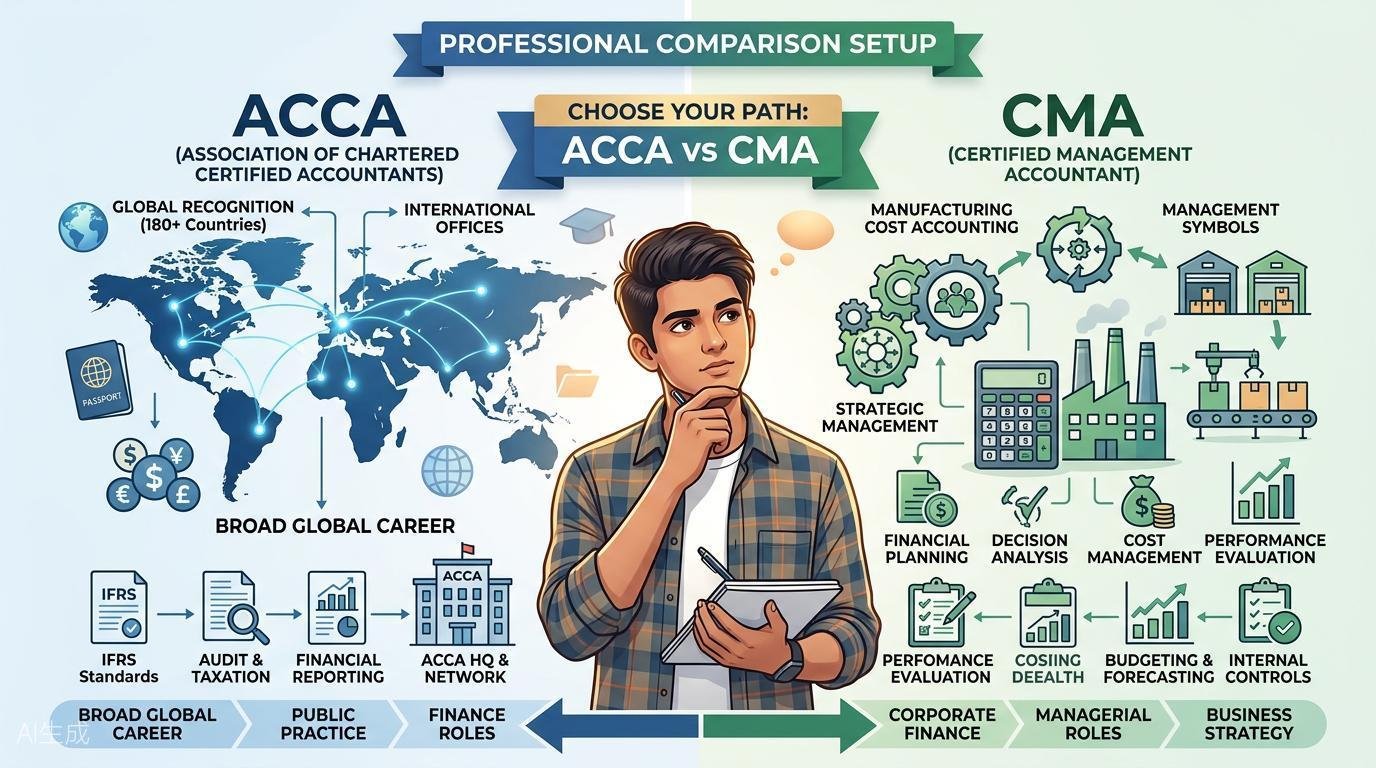
Quick Answer: ACCA or CMA — Which Should You Choose?
If you are a BCom student or young professional in India deciding between ACCA and CMA (US), here is the direct answer: Choose ACCA if you want a comprehensive global accounting qualification that covers financial reporting, audit, taxation, corporate finance and strategic business leadership across 180+ countries. Choose US CMA if you specifically want management accounting expertise with a faster, more affordable 2-part exam structure focused on cost management, performance measurement and corporate decision-making.
According to IMA's 2025 Global Salary Survey, CMA holders earn a median salary that is 58% higher than non-CMA professionals in the same roles. Meanwhile, ACCA Global's 2025 Career Navigator report shows that ACCA members in India earn 40–60% more than BCom graduates at equivalent experience levels. Both qualifications offer strong ROI — the question is which career pathway aligns with your goals.
What is ACCA? Overview & Career Scope
ACCA (Association of Chartered Certified Accountants) is a UK-based professional accounting body founded in 1904. According to ACCA Global's 2025 Annual Report, ACCA has 247,000 fully qualified members and 526,000 future members studying across 180 countries. It is widely regarded as the most globally recognized accounting qualification outside North America.
ACCA's curriculum spans three progressive levels:
- Applied Knowledge (3 papers) — Business and Technology, Management Accounting, Financial Accounting
- Applied Skills (6 papers) — Corporate and Business Law, Performance Management, Taxation, Financial Reporting, Audit and Assurance, Financial Management
- Strategic Professional (4 papers) — Strategic Business Leader, Strategic Business Reporting, plus two options from Advanced Financial Management, Advanced Performance Management, Advanced Taxation and Advanced Audit & Assurance
Students with relevant prior qualifications can claim exemptions of up to 9 papers. A typical BCom graduate receives 5 exemptions, reducing the journey from 13 to 8 papers. CA Inter students may receive up to 9 exemptions, leaving only 4 Strategic Professional papers to complete.
ACCA members can sign audit reports in the UK, UAE, Singapore, Australia and several other jurisdictions. While ACCA does not grant signing authority in India, it is recognized by MNCs, Big 4 firms, global banks and consulting companies operating in India.
What is CMA (US)? Overview & Career Scope
The US CMA (Certified Management Accountant) is awarded by the Institute of Management Accountants (IMA), a US-based professional body founded in 1919. According to IMA's 2025 Annual Report, there are over 100,000 active CMAs worldwide across more than 100 countries. Unlike ACCA, which is a comprehensive accounting qualification, CMA focuses specifically on management accounting and financial management.
The CMA program consists of just two exam parts:
- Part 1: Financial Planning, Performance and Analytics — External financial reporting decisions, planning, budgeting and forecasting, performance management, cost management, internal controls and technology and analytics
- Part 2: Strategic Financial Management — Financial statement analysis, corporate finance, decision analysis, risk management, investment decisions and professional ethics
To earn the CMA designation, candidates must:
- Hold a bachelor's degree from an accredited university
- Pass both CMA exam parts within 3 years of entering the program
- Complete 2 years of professional experience in management accounting or financial management
- Maintain active IMA membership and continuing education requirements
The CMA's focused approach means you can complete the entire qualification in 6–12 months if you are dedicated. This speed is CMA's biggest selling point for students who want a quick credential upgrade.
Detailed Comparison Table: ACCA vs CMA
| Parameter | ACCA | CMA (US) |
|---|---|---|
| Full Form | Association of Chartered Certified Accountants | Certified Management Accountant (US) |
| Administered By | ACCA Global (UK) | Institute of Management Accountants (USA) |
| Primary Focus | Accounting, audit, tax, corporate finance, strategy | Management accounting, cost management, financial planning |
| Number of Exams | 13 papers (up to 9 exemptions) | 2 parts (no exemptions) |
| Exam Frequency | 4 windows/year (Mar, Jun, Sep, Dec) | 3 testing windows/year (Jan-Feb, May-Jun, Sep-Oct) |
| Exemptions Available | Yes — up to 9 papers | No exemptions |
| Work Experience | 36 months (flexible timing) | 2 years in management accounting/finance |
| Global Reach | 180+ countries | 100+ countries |
| Signing Authority | Yes — in UK, UAE, Singapore, etc. | No — CMA is not an audit qualification |
| Total Cost in India | ₹3.5 – ₹6 lakhs | ₹1.5 – ₹3 lakhs |
| Average Duration | 2–3 years (with exemptions: 12–18 months) | 6–12 months |
| Pass Rates | 40–55% per paper | ~50% per part |
| Best For | BCom, CA Inter, comprehensive accounting careers | Working professionals seeking quick upgrade |
| Big 4 Preference | Strong preference for audit/advisory | Limited Big 4 hiring |
| MNC Preference | Very strong — MNCs recognize ACCA globally | Moderate — recognized in manufacturing MNCs |
Syllabus Comparison
While both ACCA and CMA cover accounting and finance, their syllabus structures and depths differ substantially.
ACCA Syllabus: Comprehensive and Layered
ACCA's 13-paper syllabus is designed to build expertise progressively. The Applied Knowledge level establishes foundational accounting skills. Applied Skills develops technical competence across the core domains of law, tax, audit and financial management. Strategic Professional then elevates candidates to advisory and leadership capabilities.
The optional papers at Strategic Professional level are where ACCA offers genuine specialization:
- AFM (Advanced Financial Management) — For treasury, corporate finance and banking careers
- APM (Advanced Performance Management) — For consulting, FP&A and business advisory
- ATX (Advanced Taxation) — For international tax and transfer pricing roles
- AAA (Advanced Audit & Assurance) — For audit partnership and risk consulting
This depth and breadth is why ACCA-qualified professionals can move seamlessly between audit, tax, corporate finance and consulting — a flexibility that CMA does not offer.
CMA Syllabus: Focused and Practical
CMA's 2-part syllabus is tightly focused on management accounting and corporate financial decision-making. Part 1 covers financial reporting (at a managerial level), cost management and internal controls. Part 2 covers financial statement analysis, corporate finance, risk management and investment decisions.
According to IMA's 2024 exam content specification outlines, CMA Part 1 emphasizes:
- External financial reporting (15%)
- Planning, budgeting and forecasting (20%)
- Performance management (20%)
- Cost management (15%)
- Internal controls (15%)
- Technology and analytics (15%)
CMA Part 2 emphasizes:
- Financial statement analysis (20%)
- Corporate finance (20%)
- Decision analysis (25%)
- Risk management (10%)
- Investment decisions (10%)
- Professional ethics (15%)
The practical, decision-oriented nature of CMA's syllabus makes it immediately applicable in manufacturing and corporate roles. However, it does not cover audit, taxation, or financial reporting preparation in the depth that ACCA does.
Key Syllabus Insight
ACCA's Performance Management (PM) and Financial Management (FM) papers cover approximately 60–70% of CMA's syllabus. However, CMA's cost management content is more granular and manufacturing-focused. Conversely, CMA does not cover audit, tax preparation, or strategic business leadership — all core ACCA strengths.
Cost Comparison: Total Investment in India
For cost-conscious Indian students, the financial investment is often the deciding factor. Here is the complete breakdown:
ACCA Total Cost in India
| Component | Cost (INR) |
|---|---|
| Initial Registration Fee | ₹2,500 – ₹3,500 |
| Annual Subscription | ₹10,000 – ₹12,000/year |
| Applied Knowledge Exams (3 papers) | ₹30,000 – ₹40,000 |
| Applied Skills Exams (6 papers) | ₹75,000 – ₹95,000 |
| Strategic Professional Exams (4 papers) | ₹65,000 – ₹85,000 |
| Exemption Fees (if applicable) | ₹8,000 – ₹12,000 per paper |
| Coaching & Study Material (Gold LP) | ₹80,000 – ₹1,50,000 |
| Total ACCA Investment | ₹3,50,000 – ₹6,00,000 |
CMA (US) Total Cost in India
| Component | Cost (INR) |
|---|---|
| IMA Membership (Student/Professional) | ₹10,000 – ₹18,000/year |
| CMA Entrance Fee | ₹20,000 – ₹25,000 |
| Part 1 Exam Fee | ₹30,000 – ₹35,000 |
| Part 2 Exam Fee | ₹30,000 – ₹35,000 |
| Coaching & Study Material | ₹40,000 – ₹80,000 |
| Total CMA Investment | ₹1,50,000 – ₹3,00,000 |
CMA is approximately 40–50% cheaper than ACCA in total investment. For students with budget constraints, this is a significant factor. However, consider the return on investment: ACCA's broader scope and 180-country recognition may generate higher lifetime earnings for students targeting global or Big 4 careers.
Duration & Exam Structure
ACCA Duration: Without exemptions, ACCA takes 2.5–3 years. With 5 BCom exemptions, 12–18 months. With 9 CA Inter exemptions, as little as 9–12 months for the 4 Strategic Professional papers. ACCA offers four exam windows per year, allowing candidates to pace themselves or accelerate aggressively.
CMA Duration: The average candidate completes both CMA parts in 6–12 months. With three testing windows per year (January-February, May-June, September-October), a dedicated student can attempt both parts within a single year. The IMA reports that candidates studying 10–15 hours per week typically pass both parts within 8–10 months.
Verdict on duration: CMA is unambiguously faster. If your primary goal is to add a recognized credential to your resume within a year, CMA is the better choice. If you are willing to invest 2–3 years for a more comprehensive qualification, ACCA offers greater long-term value.
Global Recognition: Where Each is Valued
Geographic recognition is where ACCA and CMA diverge most sharply.
ACCA Global Recognition
According to ACCA Global, ACCA is recognized and valued in 180+ countries. Key markets include:
- United Kingdom — Full statutory recognition; ACCA members can sign audit reports
- UAE & Middle East — ACCA is the preferred accounting qualification; full signing authority
- Singapore & Hong Kong — Strong recognition; ACCA members can register as public accountants
- Malaysia — Full recognition under the Malaysian Institute of Accountants
- Australia & Canada — Recognized; ACCA has mutual recognition agreements with CPA Australia and CPA Canada
- India — Recognized by MNCs, Big 4 and global companies; no statutory signing authority
- Africa — Strong presence across Nigeria, South Africa, Kenya and Ghana
ACCA also has MOU agreements with local accounting bodies in multiple countries, enabling ACCA members to obtain local qualifications through streamlined pathways.
CMA (US) Global Recognition
According to IMA, CMA is recognized in 100+ countries, with strongest presence in:
- United States — Full recognition for management accounting roles
- China — Very strong recognition; CMA is the most popular international management accounting qualification
- Middle East — Recognized by MNCs and manufacturing companies
- India — Growing recognition among MNCs and manufacturing sector
CMA's recognition is concentrated in management accounting roles within corporate organizations. It does not have the breadth of professional recognition that ACCA enjoys across audit, tax and advisory services.
| Region | ACCA Recognition | CMA Recognition |
|---|---|---|
| UK & Europe | Full — statutory | Limited |
| Middle East | Full — statutory | Moderate |
| Singapore | Full — public accountant | Moderate |
| India | Strong — MNCs & Big 4 | Growing — manufacturing & MNCs |
| North America | Moderate — MOU with CPA | Full — primary market |
| China | Growing | Very strong |
Career Outcomes in India
Both ACCA and CMA open doors in India, but to different segments of the job market.
ACCA Career Outcomes in India
According to LinkedIn's 2025 India hiring data and Big 4 placement reports, ACCA-qualified professionals find roles in:
- Big 4 Firms — Deloitte, PwC, EY, KPMG hire ACCA professionals for audit, tax, advisory and consulting
- MNC Corporate Finance — Companies like Amazon, Microsoft, Google, Unilever and Tata Group value ACCA for FP&A, controllership and treasury
- Global Capability Centers (GCCs) — India's rapidly expanding GCC ecosystem prefers ACCA for accounting and reporting roles
- Consulting — McKinsey, BCG, Bain and Big 4 advisory value the strategic business skills from ACCA's SBL paper
- Banking & Financial Services — HSBC, Standard Chartered, Citibank hire ACCA for compliance, risk and operations
- Startups — India's unicorn ecosystem increasingly hires ACCA-qualified CFOs and finance leaders
CMA Career Outcomes in India
According to IMA India's 2024 employment survey, CMA holders in India find roles in:
- Manufacturing — Companies like Larsen & Toubro, Mahindra, Tata Motors and Aditya Birla Group hire CMAs for cost accounting and production planning
- IT & ITES MNCs — Infosys, Wipro, TCS hire CMAs for internal finance and business analyst roles
- Pharmaceuticals — Sun Pharma, Dr. Reddy's, Cipla value CMA for product costing and profitability analysis
- Automotive — Maruti Suzuki, Hyundai, Bajaj Auto hire CMAs for supply chain finance and cost management
- Shared Service Centers — MNC back-office operations hire CMAs for FP&A and management reporting
- Consulting (Limited) — Some operational consulting firms value CMA for cost optimization projects
Career Market Size in India
According to Naukri.com's 2025 skills report, ACCA-related job postings in India outnumber CMA-related postings by approximately 3:1. This reflects ACCA's broader applicability across industries and service lines. However, in the manufacturing sector specifically, CMA holds a more competitive position.
Salary Comparison 2026
Salary data compiled from Glassdoor India, LinkedIn Salary Insights, AmbitionBox and IMA's 2025 Global Salary Survey:
| Experience Level | ACCA Salary (LPA) | CMA Salary (LPA) |
|---|---|---|
| Fresher (0–1 year) | ₹6 – ₹8 | ₹5 – ₹7 |
| Junior (2–3 years) | ₹8 – ₹12 | ₹7 – ₹10 |
| Mid-level (4–6 years) | ₹12 – ₹20 | ₹10 – ₹16 |
| Senior (7–10 years) | ₹20 – ₹35 | ₹16 – ₹25 |
| Leadership (10+ years) | ₹35 – ₹60+ | ₹25 – ₹40+ |
ACCA generally commands a 15–25% salary premium over CMA at equivalent experience levels in India. This gap is widest in consulting, Big 4 and MNC roles and narrowest in manufacturing and cost accounting positions.
However, salary is not the only metric. When you factor in the time to qualification (CMA is 6–12 months vs ACCA's 2–3 years), a CMA holder starts earning the credential premium 1–2 years earlier. For students who need to start working quickly, this time advantage can offset the lower salary ceiling.
Which is Better for Which Career Path?
| Career Goal | Recommended Qualification | Why |
|---|---|---|
| Big 4 Audit & Assurance | ACCA | ACCA's AA and AAA papers; Big 4 strongly prefer ACCA |
| Corporate Finance / FP&A | ACCA (or both) | ACCA's FM, AFM and SBL cover this comprehensively |
| Management Consulting | ACCA | SBL and APM develop strategic advisory skills |
| Cost Accounting / Manufacturing | CMA | CMA's cost management focus is deeper and more practical |
| International Tax | ACCA | ATX paper covers international taxation |
| Startup CFO | ACCA | Broader skillset covering accounting, tax and strategy |
| Quick credential upgrade | CMA | 6–12 months vs 2–3 years for ACCA |
| Global mobility (180+ countries) | ACCA | Broader geographic recognition |
| Budget-conscious option | CMA | ₹1.5–3 lakhs vs ₹3.5–6 lakhs |
| MNC controllership | ACCA | IFRS focus; MNCs prefer ACCA for reporting roles |
From Nagpur and Central India
In Nagpur's manufacturing-driven economy, CMA has a strong following because of its cost accounting focus. But ACCA offers broader career options across MNCs, consulting and global roles. We help students choose based on their industry preference.
Prepper Gurukul is an ACCA Gold Learning Partner serving Central India (Maharashtra, M.P. and Chhattisgarh). But the same principles apply whether you are studying in Mumbai, Delhi, or Dubai — our online programs and partnerships mean geography is never a barrier.
A student from a manufacturing background in Nagpur chose CMA because everyone in his family was a cost accountant. After completing it, he realized ACCA would have opened more MNC doors. He started ACCA anyway — and is now a finance manager at a German automotive company. It's never too late to add qualifications.
Final Verdict
After analyzing thousands of student journeys at Prepper Gurukul, here is our framework:
Choose ACCA if:
- You want a comprehensive accounting qualification that covers audit, tax, corporate finance and strategy
- You are targeting Big 4, MNCs, consulting, or global careers
- You have BCom or CA Inter background that qualifies for exemptions
- Geographic flexibility across 180+ countries matters to you
- You can invest 2–3 years and ₹3.5–6 lakhs for a premium qualification
- You want signing authority in countries like UAE, Singapore, or the UK
Choose CMA (US) if:
- You specifically want management accounting and cost management expertise
- You are targeting manufacturing, automotive, or pharmaceutical industries
- You need a quick credential upgrade within 6–12 months
- You have budget constraints and prefer a ₹1.5–3 lakh investment
- You are a working professional who cannot commit to a multi-year program
- You want to complement an existing accounting qualification (CA, CS)
For the majority of Indian commerce students, ACCA offers better long-term career flexibility and earning potential. However, CMA remains a viable and cost-effective option for students with specific manufacturing or cost accounting career goals, or those who need a faster route to a recognized credential.