
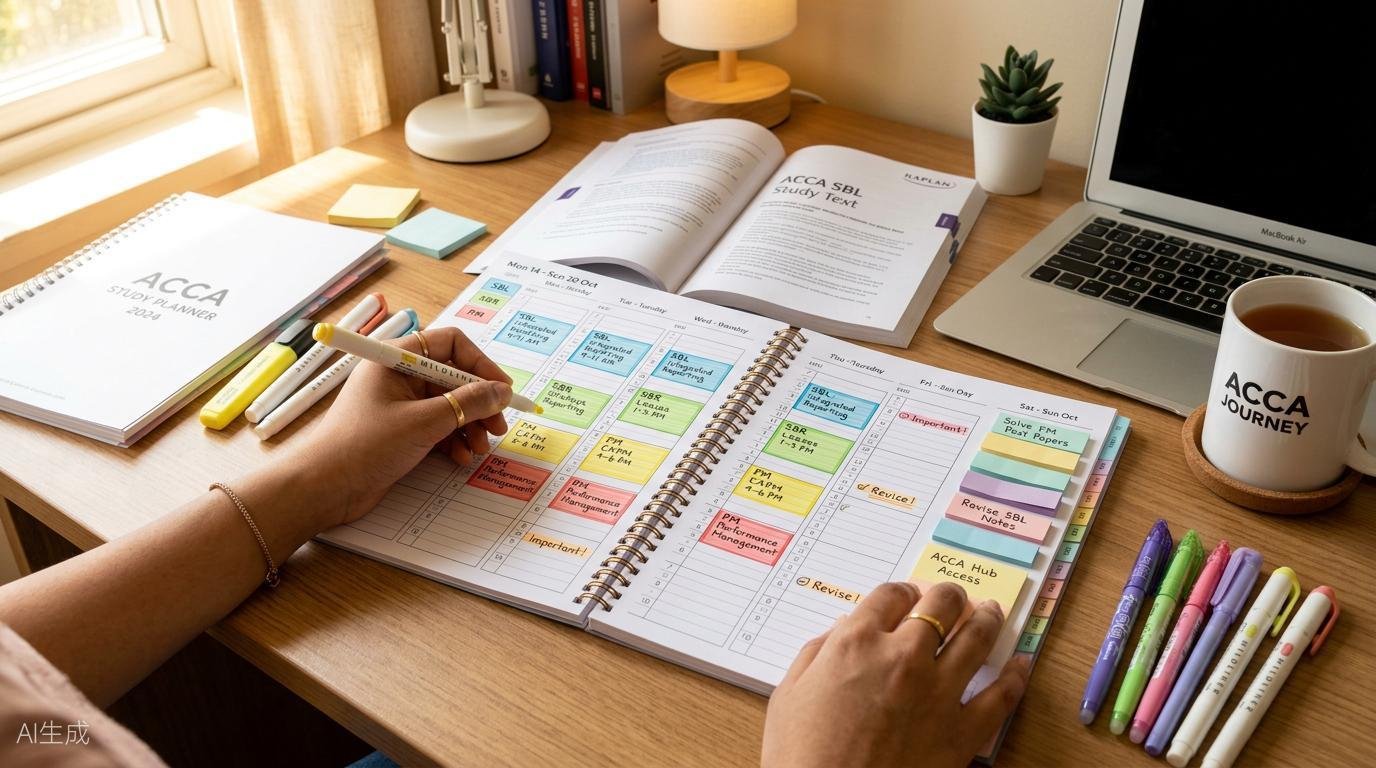
The students who fail aren't the ones who study less — they're the ones who study without a plan. A student studying 15 hours a week with a structured plan beats a student studying 25 hours a week randomly, every single time. This isn't motivational fluff — it's a pattern we've observed across thousands of ACCA students at Prepper Gurukul over the years.
According to ACCA Global's student survey data, time management and study planning consistently rank among the top three challenges students face — more than syllabus difficulty, more than exam fees, more than work commitments. The good news is that unlike innate ability, study planning is a skill anyone can learn. This guide provides complete, actionable study plans for every ACCA level, tailored for both full-time students and working professionals.
Core Principles of an Effective ACCA Study Plan
Before diving into specific schedules, understand the principles that make any study plan effective:
Consistency Over Intensity
Studying 2 hours every day produces better retention than studying 10 hours once a week. Your brain consolidates information during rest periods between study sessions. Spaced repetition — revisiting topics at increasing intervals — is one of the most evidence-backed learning strategies available.
Active Learning Over Passive Reading
Reading study texts is passive. Attempting practice questions, explaining concepts aloud, teaching a peer and writing summary notes are active. Your study plan should allocate at least 60% of your time to active learning methods, especially as you approach the exam.
Mock Exams Are Non-Negotiable
No study plan is complete without a mock exam schedule. Plan for at least 4-6 full mock exams per paper, spaced throughout your preparation, not crammed at the end. The final 2-3 mocks should be in full exam conditions.
Build in Buffer Time
Life happens. You'll have bad days, work emergencies, family commitments and days when you simply can't focus. A good study plan builds in 15-20% buffer time so that missing one day doesn't derail your entire schedule.
Applied Knowledge Level: BT, MA, FA
The Applied Knowledge level consists of three papers: Business and Technology (BT), Management Accounting (MA) and Financial Accounting (FA). These are on-demand, computer-based exams that you can sit anytime at an ACCA-approved centre. Each requires approximately 6-8 weeks of preparation.
Study Plan Overview
- Duration per paper: 6-8 weeks
- Weekly study hours: 15-20 hours
- Daily average: 2-3 hours on weekdays, 4-5 hours on weekends
- Mock exams: 4-5 per paper
Weeks 1-3: Concept Foundation
Monday-Friday (2 hours/day): Study text reading with active note-taking. Cover 2-3 chapters per week. Complete end-of-chapter practice questions.
Saturday (4 hours): Live online class or recorded lecture session. Review week's concepts. Attempt 20-30 practice questions.
Sunday (3 hours): Weekly revision — review notes, create summary sheets, attempt a short timed quiz (30-40 minutes).
Weeks 4-5: Practice Intensive
Monday-Friday (2.5 hours/day): Shift focus to practice questions. Attempt 15-20 questions daily from the BPP/Kaplan practice kit. Review solutions for every wrong answer.
Saturday (5 hours): Live class focusing on difficult topics. Attempt 40-50 mixed practice questions covering all topics studied so far.
Sunday (4 hours): First timed section test (1 hour). Review performance. Revise weak areas identified.
Weeks 6-7: Mock Exam Phase
Monday-Friday (2 hours/day): Mixed practice questions (10-15/day). Focus on weak areas identified in section tests. Review summary notes daily.
Saturday (5 hours): Full mock exam under timed conditions (2 hours for Knowledge papers). Detailed review of all answers.
Sunday (4 hours): Second full mock exam. Review. Create final revision notes for persistently weak topics.
Week 8: Final Revision
Monday-Friday (2 hours/day): Review summary notes only. Attempt 5-10 questions daily to maintain sharpness. No new topics.
Saturday: Final mock exam or timed practice. Light review of formula sheets and key concepts.
Sunday: Rest and light revision only. Early sleep — exam likely this week.
Applied Skills Level: LW, PM, TX, FR, AA, FM
The Applied Skills level consists of six papers: Corporate and Business Law (LW), Performance Management (PM), Taxation (TX), Financial Reporting (FR), Audit and Assurance (AA) and Financial Management (FM). These are 3-hour CBE exams sat during ACCA's quarterly exam windows. Each requires approximately 8-10 weeks of preparation.
Study Plan Overview
- Duration per paper: 8-10 weeks
- Weekly study hours: 20-25 hours
- Daily average: 3 hours on weekdays, 5-6 hours on weekends
- Mock exams: 5-6 per paper
Weeks 1-4: Concept Foundation + Initial Practice
Monday-Friday (3 hours/day): 1.5 hours study text reading, 1.5 hours practice questions. Cover 1-2 chapters per week. Complete all end-of-chapter questions before moving on.
Saturday (5 hours): Live online class covering 2-3 topics. Post-class practice session (2 hours). Attempt 25-30 questions.
Sunday (4 hours): Weekly revision and first timed section test (45-60 minutes). Review mistakes. Update weak topics list.
Weeks 5-6: Intensive Practice
Monday-Friday (3 hours/day): 1 hour quick revision of notes, 2 hours practice questions (20-25/day). Focus on weak areas. Start mixing questions from different chapters.
Saturday (6 hours): Live revision class. Attempt 50+ mixed practice questions. Review all solutions.
Sunday (5 hours): First full mock exam (3 hours timed). Detailed review (2 hours). Identify persistent problem areas.
Weeks 7-8: Mock Exam Intensive
Monday-Friday (2.5 hours/day): 1 hour targeted revision of weak areas, 1.5 hours practice questions (15-20/day).
Saturday (5 hours): Full mock exam (3 hours) + review (2 hours).
Sunday (5 hours): Second full mock exam (3 hours) + review (2 hours). Compare performance with first mock.
Weeks 9-10: Final Revision
Monday-Friday (2 hours/day): Summary notes review only. 30-45 minutes light practice to maintain sharpness.
Saturday: Final mock exam in full exam conditions. Or if confident, timed section practice on weakest area.
Sunday: Final review of formula sheets, standards summaries and key mnemonics. Rest well.
Strategic Professional: SBL, SBR + Optionals
The Strategic Professional level consists of two compulsory papers — Strategic Business Leader (SBL) and Strategic Business Reporting (SBR) — plus two optional papers chosen from Advanced Financial Management (AFM), Advanced Performance Management (APM), Advanced Taxation (ATX) and Advanced Audit and Assurance (AAA). These are the most demanding ACCA papers, requiring approximately 10-12 weeks of preparation each.
Study Plan Overview
- Duration per paper: 10-12 weeks
- Weekly study hours: 25-30 hours
- Daily average: 3-4 hours on weekdays, 6-7 hours on weekends
- Mock exams: 6-8 per paper
Weeks 1-5: Foundation + Case Study Practice
Monday-Friday (3-4 hours/day): 2 hours study text/technical articles, 1-2 hours practice. For SBL, focus on case study technique. For SBR, master standards application.
Saturday (6 hours): Live class with case study work. Group discussion and analysis. Attempt case-style questions.
Sunday (5 hours): Weekly revision. Timed section test (1 hour). Read ACCA examiner's reports for previous sittings.
Weeks 6-8: Mock Exam Phase
Monday-Friday (3 hours/day): 1 hour revision, 2 hours practice questions/case studies. Attempt at least one full case study question per week for SBL.
Saturday (6 hours): Full mock exam (SBL = 4 hours, SBR/optional = 3 hours). Detailed review with faculty feedback.
Sunday (5 hours): Second full mock or intensive case study practice. Technical article reading.
Weeks 9-10: Final Revision
Monday-Friday (2-3 hours/day): Summary notes, formula sheets, standards summaries. Light practice to maintain sharpness.
Saturday: Final mock exam or focused practice on weakest areas.
Sunday: Rest and final light revision. Examiner technique review.
Weekly Schedule Template (Monday-Friday)
Here's a template for structuring your weekday study time. Adjust based on whether you're a morning person or evening person:
| Time Slot | Activity | Duration | Purpose |
|---|---|---|---|
| 6:00 AM - 7:30 AM (or after work) | Concept study / reading | 1.5 hours | Fresh mind for difficult concepts |
| During commute (if applicable) | Audio revision / flashcards | 30-45 min | Passive reinforcement |
| Evening: 8:00 PM - 9:30 PM | Practice questions | 1.5 hours | Apply what you studied |
| Before sleep | Quick review of day's notes | 15-20 min | Consolidation |
Weekend Revision Strategy
Weekends are your most valuable study time — they're when you can attempt full mock exams, attend live classes and do deep revision. Protect your weekend study time fiercely.
Saturday Structure: Start with a live class or recorded lecture session (2-3 hours). Take a 30-minute break. Then do intensive practice — either a full mock exam or 50+ practice questions (3-4 hours). End with review of all attempted questions (1 hour).
Sunday Structure: Begin with a timed section test or shorter mock (1-2 hours). Spend the rest of the day on revision — reviewing notes, creating summary sheets, watching revision videos and reading examiner reports. Keep Sunday evening free to rest before the work week.
How to Balance ACCA With a Full-Time Job
Working professionals face the biggest time constraint in ACCA preparation, but thousands clear ACCA while working full-time every year. The key is realistic planning:
- Attempt fewer papers: 1 paper per sitting at Skills level, 1 at Strategic Professional. Quality over quantity.
- Use weekend batches: Most coaching institutes offer Saturday-Sunday classes designed for working professionals.
- Leverage recorded lectures: Watch recordings during weekday evenings when live classes aren't possible.
- Study during commute: Use flashcard apps, audio lectures, or revision videos during travel time.
- Start earlier: Add 2-4 weeks to the standard preparation timeline to account for work disruptions.
- Use lunch breaks: 30-45 minutes of light practice questions during lunch adds 2.5-4 hours per week.
How to Balance ACCA With College
College students often have the advantage of time but the disadvantage of divided attention between ACCA and university exams. Here's how to manage both:
- Align exam windows: Plan ACCA exams after your college exams when possible, so preparation periods don't overlap.
- Use college holidays: Summer and winter breaks are golden periods for intensive ACCA preparation.
- Choose complementary papers: If your college syllabus overlaps with ACCA content (e.g., Financial Accounting in BCom and FA in ACCA), attempt those papers when the college material is fresh.
- Study in college gaps: Use free periods between lectures for ACCA practice questions.
- Join a structured batch: A coaching batch with fixed timings creates accountability that self-study lacks.
Study Hours by Level: Working vs Non-Working Students
| ACCA Level | Full-Time Student (hrs/week) | Working Professional (hrs/week) | Preparation Duration | Papers Per Sitting |
|---|---|---|---|---|
| Applied Knowledge (BT, MA, FA) | 15-20 hours | 20-25 hours | 6-8 weeks per paper | 2-3 (student), 1-2 (working) |
| Applied Skills (LW, PM, TX, FR, AA, FM) | 20-25 hours | 25-30 hours | 8-10 weeks per paper | 2-3 (student), 1-2 (working) |
| Strategic Professional (SBL, SBR, Options) | 25-30 hours | 30-35 hours | 10-12 weeks per paper | 1-2 (student), 1 (working) |
ACCA Exam Window Planning for 2026
ACCA offers four exam windows each year: March, June, September and December. Strategic planning of which papers to attempt in which window can significantly impact your success:
| Exam Window | Best For | Considerations |
|---|---|---|
| March | Students with winter break preparation time | Good for Indian students who have college holidays in Dec-Jan |
| June | Full-time students post-college exams | Most popular window; book early for preferred CBE centre slots |
| September | Working professionals (post-appraisal period) | Less crowded than June; good availability at CBE centres |
| December | Students with summer break prep (if aligned) | Good for final papers; festive season may distract some |
Our recommendation: If you're a college student, target the March and June windows when you have holiday preparation time. If you're a working professional, the September and March windows often work best as they align with calmer periods in the corporate calendar.
From Nagpur and Central India: Our Nagpur centre provides structured batch schedules that align with ACCA's 4 exam windows. Whether you're a college student or working professional, we have a study plan that fits your schedule. Our weekend batches are particularly popular among working professionals from Nagpur and nearby towns like Amravati and Wardha.
Faculty Perspective: The Power of Structured Planning
The students who fail aren't the ones who study less — they're the ones who study without a plan. A student studying 15 hours a week with a structured plan beats a student studying 25 hours a week randomly, every single time.
One of our students — a BCom final year student from Central India — came to us after failing Financial Reporting (FR) twice. She was studying 4-5 hours daily, which should have been more than enough. The problem? She had no plan. She would read whatever she felt like reading on any given day, skip difficult topics "for later," and never attempted a full mock exam until three days before the real exam. Her 25+ hours per week were producing less learning than another student's 15 focused hours.
We gave her a structured 10-week plan: specific chapters on specific days, practice question targets for each week, mock exam dates locked in advance and revision checkpoints every Sunday. She followed it religiously. Her actual study time dropped to 18 hours per week — but every hour was purposeful. She scored 58 in her next FR attempt. The difference wasn't effort — it was structure.
Sample 12-Month ACCA Timeline (With BCom Exemptions)
For a BCom graduate with 5 exemptions (up to Applied Knowledge and some Skills papers), here's a realistic 12-month timeline:
| Period | Papers | Study Focus |
|---|---|---|
| Jan - Mar (Window 1) | FR, AA | 10 weeks preparation, 2 papers |
| Apr - Jun (Window 2) | PM, FM | 10 weeks preparation, 2 papers |
| Jul - Sep (Window 3) | SBR | 12 weeks preparation, 1 paper |
| Oct - Dec (Window 4) | SBL + Optional (AFM/APM) | 12 weeks preparation, 2 papers |
This timeline assumes you're studying full-time or part-time with significant study hours. Working professionals should extend this to 18-24 months, attempting 1 paper per sitting at Strategic Professional level.
Key Takeaways for Your ACCA Study Plan
- Start with a written plan — not a vague intention to "study every day"
- Schedule mock exams in advance and treat them as immovable deadlines
- Build 15-20% buffer time for life's inevitable disruptions
- Review and adjust your plan weekly based on actual progress
- Prioritise active learning (practice questions, teaching others) over passive reading
- Protect your weekend study time — it's when the most valuable work gets done
The right study plan won't just help you pass exams faster — it will reduce stress, improve retention and give you confidence that you're on track every step of the way.