Why Mock Exams Are the #1 Predictor of ACCA Success
Every ACCA student understands the importance of studying the syllabus. Far fewer understand the importance of practising under exam conditions. According to ACCA Global's own research and our internal tracking at Prepper Gurukul, mock exam performance is the single most reliable predictor of whether a student will pass or fail their real ACCA exam.
Here is why: knowing the material and being able to apply it under time pressure are two completely different skills. Many students can solve a question correctly when they have unlimited time and access to notes. But in the exam hall, with the clock ticking and adrenaline surging, the same student freezes, misreads questions, or runs out of time.
Mock exams bridge this gap. They train your brain to perform under pressure, expose gaps in your knowledge that passive revision hides and build the mental stamina needed for 3-hour Strategic Professional papers. Students who treat mock exams as an optional extra are effectively walking into the real exam untrained.
The Numbers Don't Lie
80%
Pass rate for students averaging 55%+ on mocks
40%
Pass rate for students who skip mock exams entirely
60%+
Mock score benchmark for exam readiness
3-4
Minimum mocks to take before each exam
According to a 2024 survey by BPP Learning Media, students who completed four or more timed mock exams before their ACCA sitting were 2.1 times more likely to pass than those who did none. The correlation is so strong that some coaching providers now refuse to enter students for exams until they have hit a minimum mock score threshold.
Free Mock Exam Sources
High-quality mock exams do not need to cost money. Several excellent free sources exist and for many students, these are entirely sufficient.
ACCA Study Hub (Free Official Mocks)
According to ACCA Global, the ACCA Study Hub includes free mock exams for every ACCA paper. These are official ACCA-authored mocks, meaning the question style, difficulty and format closely mirror the real exam. The Study Hub also provides auto-marking for objective test questions and model answers for constructed response questions.
For Applied Knowledge and Applied Skills papers, the Study Hub mocks are particularly valuable because they replicate the exact CBE software interface you will see on exam day.
ACCA Practice Platform (Past Papers & Specimens)
ACCA provides free specimen exams and past papers for all papers on its official practice platform. These are real questions from previous exam sittings — the closest thing to the actual exam you can practise. According to ACCA Global, specimen exams are updated every time the syllabus changes, so always ensure you are practising the 2026 version.
We recommend completing every available past paper for your paper from the last four exam sittings. For popular papers like Financial Reporting (FR) and Performance Management (PM), this gives you 8+ full exams of practice material.
OpenTuition (Free Mock Exams)
OpenTuition offers free mock exams for all ACCA papers, complete with solutions and marking guides. While not official ACCA questions, OpenTuition's mocks are written by experienced ACCA tutors and closely follow the exam style and syllabus weightings. The OpenTuition discussion forum is also invaluable — you can post your answers and receive feedback from tutors and other students.
BPP Free Resources
BPP Learning Media periodically releases free sample mock questions and mini-mocks on its website. While not full-length exams, these are useful for targeted practice on specific syllabus areas. BPP also offers a free "First Mock" for enrolled students.
Kaplan Free Resources
Similarly, Kaplan Publishing offers free sample questions and one free mock exam per paper on its website. Kaplan's free mocks are generally well-regarded for their realism and detailed solutions.
Paid Mock Exam Sources
While free resources are sufficient for many students, paid mock exams offer additional benefits: more detailed marking, a wider variety of questions and sometimes personalised feedback from tutors.
BPP Practice & Revision Kits
BPP's Practice & Revision Kit contains hundreds of exam-standard questions and two full mock exams per paper. The solutions are comprehensive, showing not just the answer but the approach and examiner-style marking scheme. Price: ₹3,000–₹4,500 per paper.
Kaplan Exam Kit
Kaplan's Exam Kit is widely considered the gold standard for ACCA practice questions. Each kit contains extensive past-exam-style questions and at least two full mock exams. The question quality is consistently rated the highest by ACCA students. Price: ₹2,500–₹4,000 per paper.
Becker Mock Exams
Becker includes full-length mock exams as part of its course packages. Becker's mocks integrate with their Adapt2U technology, which tracks your performance across multiple mocks and identifies persistent weak areas. Price: included in course packages (₹50,000+).
Coaching Provider Mocks
Most ACCA coaching providers, including Prepper Gurukul, conduct their own mock exams as part of their programmes. These mocks are often particularly valuable because they are designed to match the specific teaching approach and problem-solving techniques taught in class. At Prepper Gurukul, our mocks are reviewed by ACCA-experienced faculty to ensure they reflect the latest examiner trends.
How to Simulate Real Exam Conditions at Home
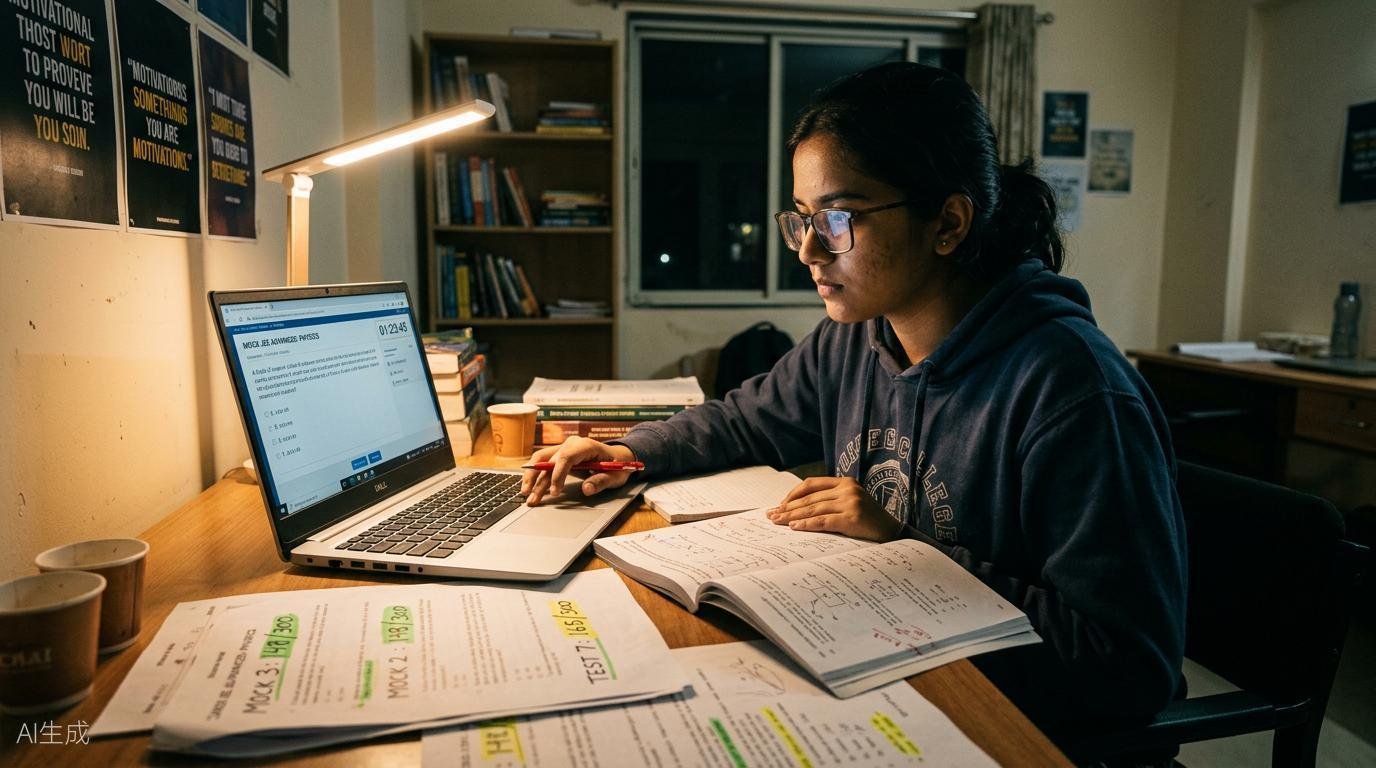
Taking a mock exam while lying on your bed with Netflix playing in the background is not mock practice — it is a waste of time. To get real value from mocks, you must replicate exam conditions as closely as possible.
Step-by-Step Exam Simulation Protocol
- Choose a quiet, distraction-free environment. No phone, no music, no notifications. If possible, use a room away from family members or roommates.
- Use a timer matching the exact exam duration. Applied Knowledge papers: 2 hours. Applied Skills: 3 hours. Strategic Professional: 3 hours 15 minutes (SBL is 4 hours). Do not give yourself extra time.
- For CBE papers, use a computer — not pen and paper. The ACCA CBE interface has specific formatting requirements. Practising on paper and then switching to computer on exam day is a common source of failure.
- No notes, no textbook, no formula sheet (unless provided in the real exam). If you do not know a formula, guess and move on — just like in the real exam.
- Take the full exam in one sitting. No breaks, no pausing the timer. Build the mental stamina needed for the real thing.
- Wear a watch and practise time allocation. For a 3-hour exam with 3 questions, allocate roughly 1 hour per question. Do not spend 2 hours on Question 1.
- Attempt every question. In the real exam, leaving a question blank guarantees zero marks. Practise making educated guesses when unsure.
- Mark your own answers strictly. Use the official marking scheme. Do not give yourself the benefit of the doubt — examiners won't.
Mock Exam Scoring: What Score Means You're Ready?
ACCA's passing mark is 50%. However, we strongly recommend aiming higher on mocks to account for exam-day pressure and unexpected difficult questions.
| Mock Average Score | Readiness Level | Recommendation |
|---|---|---|
| 70%+ consistently | Very strong — exam ready | Light revision, focus on maintaining performance. Consider sitting the exam early. |
| 60–70% | Strong — likely to pass | Review weak areas, take 1-2 more mocks. You are on track. |
| 50–60% | Borderline — possible pass | Intensive focus on knowledge gaps. Take at least 2 more mocks before deciding to sit. |
| 40–50% | Weak — at risk of failing | Do not sit the exam yet. Re-study weak topics, then re-mock in 2-3 weeks. |
| Below 40% | Not ready — high fail risk | Defer the exam. Significant knowledge gaps exist. Re-study from Study Text before mocking again. |
Important nuance: A single high score does not guarantee readiness. Consistency across 3-4 mocks matters more than one good performance. We have seen students score 70% on their first mock (often because they have seen the questions before) and then drop to 45% on a fresh mock. Always use new, unseen questions for your final readiness assessment.
How to Analyse Mock Exam Results and Improve
Taking mocks without proper analysis is like weighing yourself without changing your diet. The real learning happens in the review. Here is the system we teach at Prepper Gurukul:
The Four-Category Error Analysis
For every question you got wrong, categorise it into one of four types:
- Knowledge Gap (Type K) — You simply did not know the concept, formula, or standard. This requires returning to the Study Text or technical articles to learn it from scratch.
- Application Error (Type A) — You knew the concept but applied it incorrectly. This is the most common error type. It requires targeted practice on similar questions until the application becomes automatic.
- Silly Mistake (Type S) — Calculation error, misread the question, or forgot to carry a figure forward. These are painful but easy to fix with more careful checking during the exam.
- Time Pressure (Type T) — You ran out of time and either guessed or left the question incomplete. This requires better time allocation practice and possibly skipping difficult questions earlier.
Track Your Progress
Keep a simple spreadsheet with your mock scores and the count of each error type per mock. Over 3-4 mocks, you should see:
- Knowledge Gap errors decreasing (you are learning the syllabus)
- Application errors decreasing (you are getting better at applying knowledge)
- Silly mistakes decreasing (you are becoming more careful)
- Time pressure errors decreasing (you are managing time better)
Focus Your Revision
Between mocks, do not re-read the entire Study Text. Focus only on the topics where you made Knowledge Gap and Application errors. This targeted approach is 3-4 times more efficient than generic revision.
Timing Strategy: When to Start Mocks
The timing of when you start taking mocks is critical. Too early and you will score poorly and lose confidence. Too late and you will not have enough time to fix the gaps that mocks reveal.
Recommended Mock Timeline
| Weeks Before Exam | Activity | Focus |
|---|---|---|
| 6-8 weeks before | Complete Study Text, attempt chapter-end questions | Build knowledge base, do NOT take full mocks yet |
| 4-5 weeks before | Start practice questions from Exam Kit, untimed | Learn question technique, identify weak areas |
| 3 weeks before | First full mock exam (timed, exam conditions) | Baseline assessment — expect 45-55% |
| 2 weeks before | Second and third full mocks + error analysis | Targeted revision based on error categories |
| 1 week before | Fourth full mock + light revision | Confirm readiness, build confidence |
| 2-3 days before | Short revision of notes and common errors only | No new mocks — rest and consolidate |
For Strategic Professional papers, start this timeline one week earlier. SBL and SBR require more mock practice due to their case-study format and higher failure rates.
Free vs Paid Mock Resources: Comparison Table
| Feature | Free Resources | Paid Resources |
|---|---|---|
| Source examples | ACCA Study Hub, Practice Platform, OpenTuition | BPP Kit, Kaplan Kit, Becker, coaching mocks |
| Question quality | Official ACCA questions are excellent; others vary | Consistently high, tutor-reviewed |
| Number of mocks | 2-4 full mocks per paper + unlimited past papers | 2-4 mocks per kit + hundreds of section questions |
| Solutions detail | Model answers provided; limited explanation | Detailed step-by-step solutions with examiner approach |
| Marking/feedback | Self-marking only | Some providers offer tutor marking (extra cost) |
| CBE simulation | ACCA Practice Platform matches real software | BPP/Kaplan software also simulates CBE well |
| Cost | Free | ₹2,500–₹4,500 per paper (kits) |
| Best for | Most students, especially at Knowledge level | Students who have failed before, Strategic Pro level |
Gold Learning Partner Advantage
As an ACCA Gold Learning Partner, Prepper Gurukul designs mock exams that align with current examiner trends and the latest syllabus updates. Our faculty reviews every mock question to ensure it reflects the style and difficulty level students will face in the 2026 exam windows. This is a key benefit of studying with a Gold LP — the mocks are not generic; they are curated for exam success.
From Nagpur and Central India:
Prepper Gurukul conducts full-length mock exams every weekend in the 3 weeks leading up to each ACCA exam window. Our Nagpur students take these under strict exam conditions — because passing a mock in your bedroom and passing under exam hall pressure are two very different things. Prepper Gurukul is an ACCA Gold Learning Partner serving Central India (Maharashtra, M.P. and Chhattisgarh). But the same principles apply whether you are studying in Mumbai, Delhi, or Dubai — our online programmes and partnerships mean geography is never a barrier.
"The correlation is clear: students who average 55%+ on our mocks pass the real exam 80% of the time. Students who skip mocks and go directly to the exam? Their pass rate drops to 40%. Mock exams aren't optional — they're the dress rehearsal. At Prepper Gurukul, we have seen students who knew the entire syllabus backwards fail because they had never practised under timed conditions. The exam hall is a different world — mocks are how you prepare for it."
— ACCA Faculty, Prepper GurukulCommon Mock Exam Mistakes to Avoid
Even students who take mocks often waste the opportunity by making these errors:
1. Taking Mocks Too Late
Students who take their first mock 3 days before the exam have no time to act on what they learn. Start mocks 2-3 weeks before to allow time for improvement.
2. Not Simulating Exam Conditions
Open-book mocks with Google access and unlimited time create false confidence. Always replicate exam conditions — no notes, strict timer, continuous sitting.
3. Cheating on Self-Marking
"I knew that really, I just made a silly mistake" — this is the most common form of self-deception. Mark strictly using the official marking scheme. If your answer does not match the model answer, you do not get the marks. Full stop.
4. Taking the Same Mock Twice
Your score on a second attempt at the same mock is meaningless. Always use fresh, unseen questions. There are enough free past papers available that you should never need to repeat.
5. Ignoring the Time Factor
A correct answer that takes 45 minutes to produce is worthless in a 3-hour exam. Always practise under time pressure. Speed and accuracy together are what matter.
Paper-Specific Mock Strategies
Different ACCA papers require different mock approaches:
Applied Knowledge (BT, MA, FA)
These are 2-hour CBE papers with objective test questions (OTs) and multi-task questions (MTQs). Focus on speed — you have roughly 2 minutes per OT question. Practise using the ACCA CBE practice platform to get comfortable with the software interface.
Applied Skills (LW, PM, TX, FR, AA, FM)
These are 3-hour CBE papers mixing OTs with constructed response questions. Your mocks must include both question types. For calculation-heavy papers (PM, FM, FR), practise using the spreadsheet and word processing tools in the CBE software.
Strategic Business Leader (SBL)
SBL is a 4-hour integrated case study. This is the paper where mocks are most critical. You need to practise reading a long case, extracting relevant information and writing professional responses — all under severe time pressure. Take at least 4 full SBL mocks before the real exam.
Strategic Business Reporting (SBR)
SBR requires application of accounting standards to complex scenarios. Your mocks should focus on the style of discursive and calculation questions that combine multiple standards. Read the technical articles alongside your mock practice.
Strategic Professional Options (AFM, APM, ATX, AAA)
These are the hardest ACCA papers with the lowest pass rates. Take 4-5 mocks each. For AFM, focus on the calculation-heavy Section A. For APM and AAA, practise the discursive, advisory-style questions that require professional judgement.